

 VIII

Blog Settings
Name, author, search details, colors, header links, and footer.
This page explains every blog setting: the name and logo, the author, search and sharing details, colors, and the links in the blog's header and footer.
The settings are in one dialog with five tabs. You see the same tabs when you create a blog and when you edit one. To edit a blog, go to Blog → Blogs, open the menu on its row, and click Edit. Change what you need on any tab, then click Save Changes.
Changes show on the live blog within a minute.
General
The General tab names the blog and sets what shows in its header.
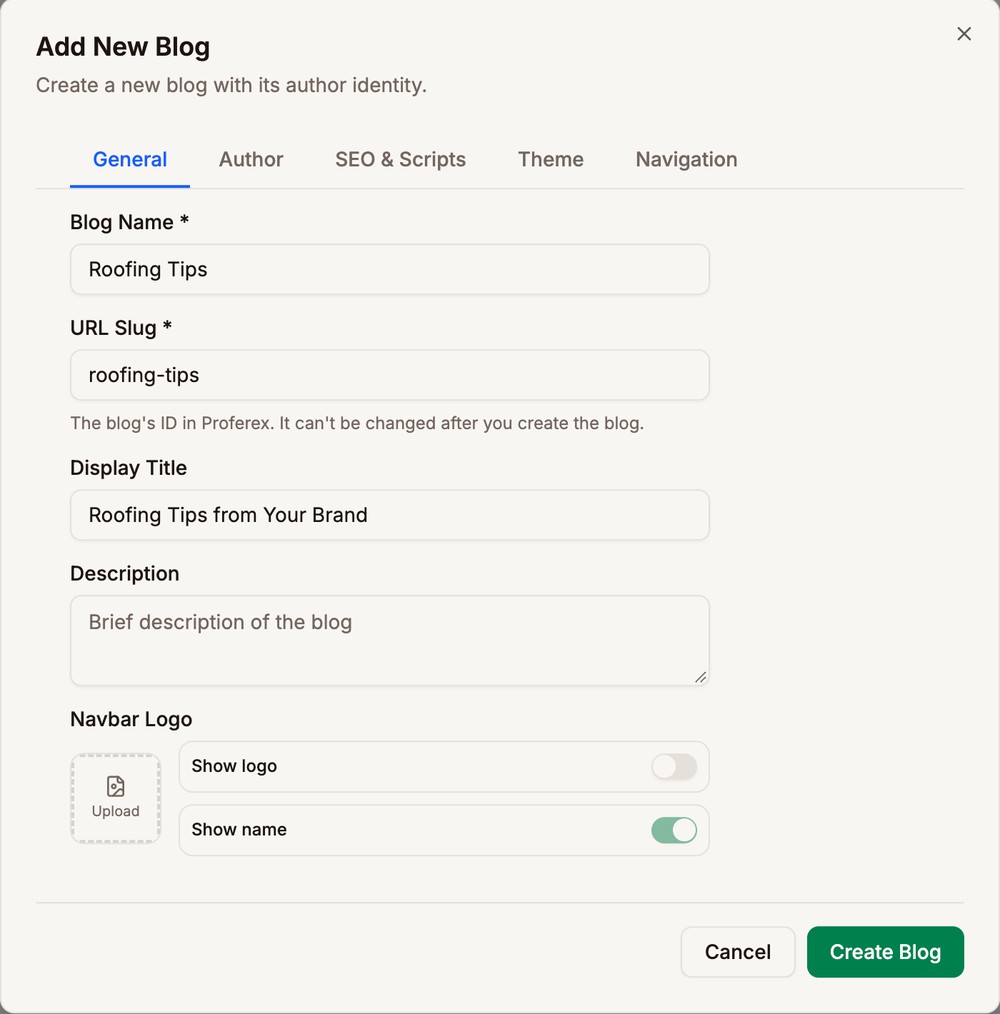
| Setting | What it does |
|---|---|
| Blog Name | The blog's name. It shows in the header and in the copyright line at the bottom of every page. Required. |
| URL Slug | The blog's ID in Proferex. It is set when you create the blog and can't be changed. |
| Display Title | The heading at the top of the home page article list. If you leave it empty, the blog name is used. |
| Description | The line under that heading. It is also the description search engines show for the home page, unless you set a Meta Description. |
| Navbar Logo | The logo in the header. It also shows in the Full footer. |
| Show logo, Show name | Whether the header shows the logo, the name, or both. One of the two always stays on. |
Author
The Author tab sets your own author profile, which new articles carry until you choose someone else. Articles say "Written by" and the Name, with a link to the author's page.
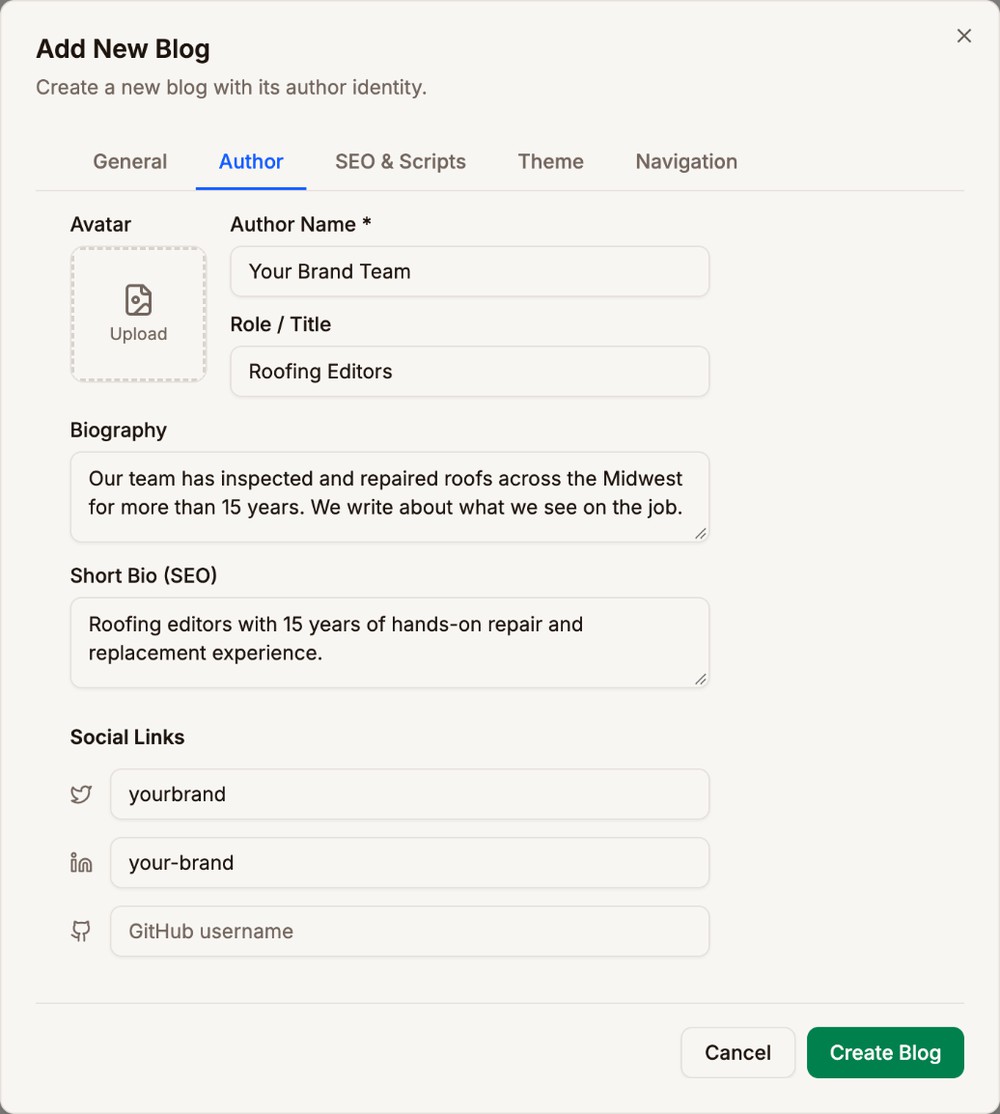
| Setting | What it does |
|---|---|
| Picture | The author's picture, on the author page and in your list of blogs |
| Name | The name on every article and at the top of the author page. Required. |
| Role | A line under the name on the author page, such as Roofing Editors |
| Bio | The text on the author page |
| Short bio | One line Google shows for the author page. Keep it under about 160 characters. |
| Social links | Your X, LinkedIn, and GitHub usernames, without the @. They become links on the author page. |
| Text before the name | The words above the author's name on every article. Leave it empty for Written by. A language blog might use Lesson by. |
| Author for AI posts | The author on articles made by Agent Chat or another AI app, unless they name someone else. The person using the AI puts that person's own name on them. |
SEO & Scripts
The SEO & Scripts tab sets how the blog's addresses look, how the blog appears in search results and when someone shares it. It also lets you add code to every page.
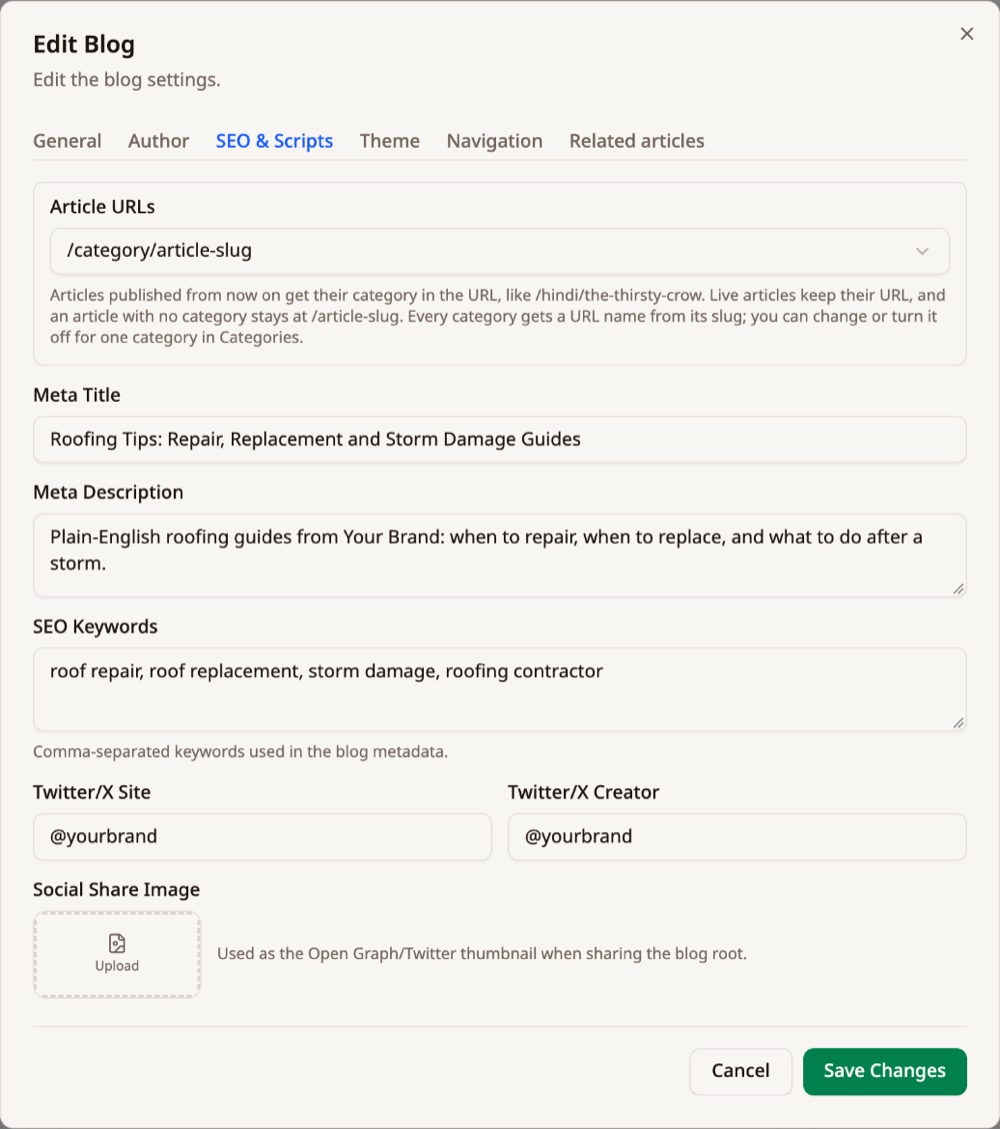
| Setting | What it does |
|---|---|
| Article URLs | /article-slug (the default) or /category/article-slug, such as /roof-repair/signs-roof-needs-replacing. The category version gives every category a URL name and applies to articles published from then on; live articles keep their address. See Categories. |
| Meta Title | The title search engines show for the blog's home page |
| Meta Description | The description search engines show for the home page. Aim for 150 to 160 characters. |
| SEO Keywords | Keywords for the blog, separated by commas |
| Twitter/X Site, Twitter/X Creator | Your brand's and the author's X handles, used when a link is shared on X. Proferex adds the @ if you leave it out. |
| Social Share Image | The picture shown when someone shares the blog's home page, or any page without its own featured image, on social media or in a chat app |
| Favicon | The small icon in the browser tab. Use a square PNG. |
| Head Scripts | Code that runs on every page of the blog, such as an analytics or chat snippet. Paste the full <script> tags. |
Articles and pages have their own Meta Title and Meta Description. The blog's settings only apply to the home page. If the home page has its own SEO settings, those win. See Pages.
Theme
The Theme tab changes the blog's colors. Each color starts empty, which keeps the default.
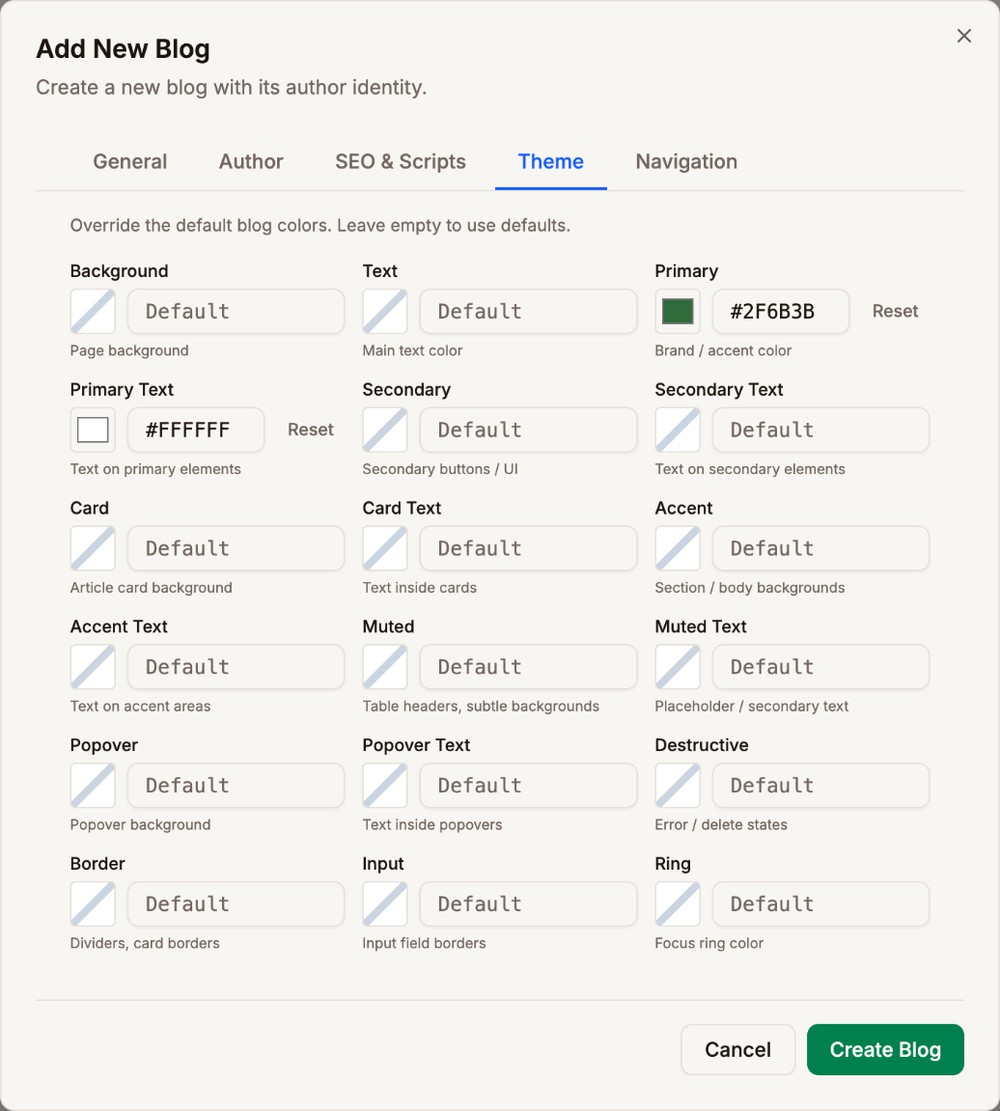
Click the color square to pick a color, or type a hex code such as #2F6B3B. Click Reset to go back to the default. The hint under each color says where it is used.
Most blogs only need two colors:
- Primary is your brand color. It colors buttons and links.
- Primary Text is the text on top of Primary. Pick white or black, whichever is easier to read.
Navigation
The Navigation tab sets the links in the blog's header and what its footer shows.
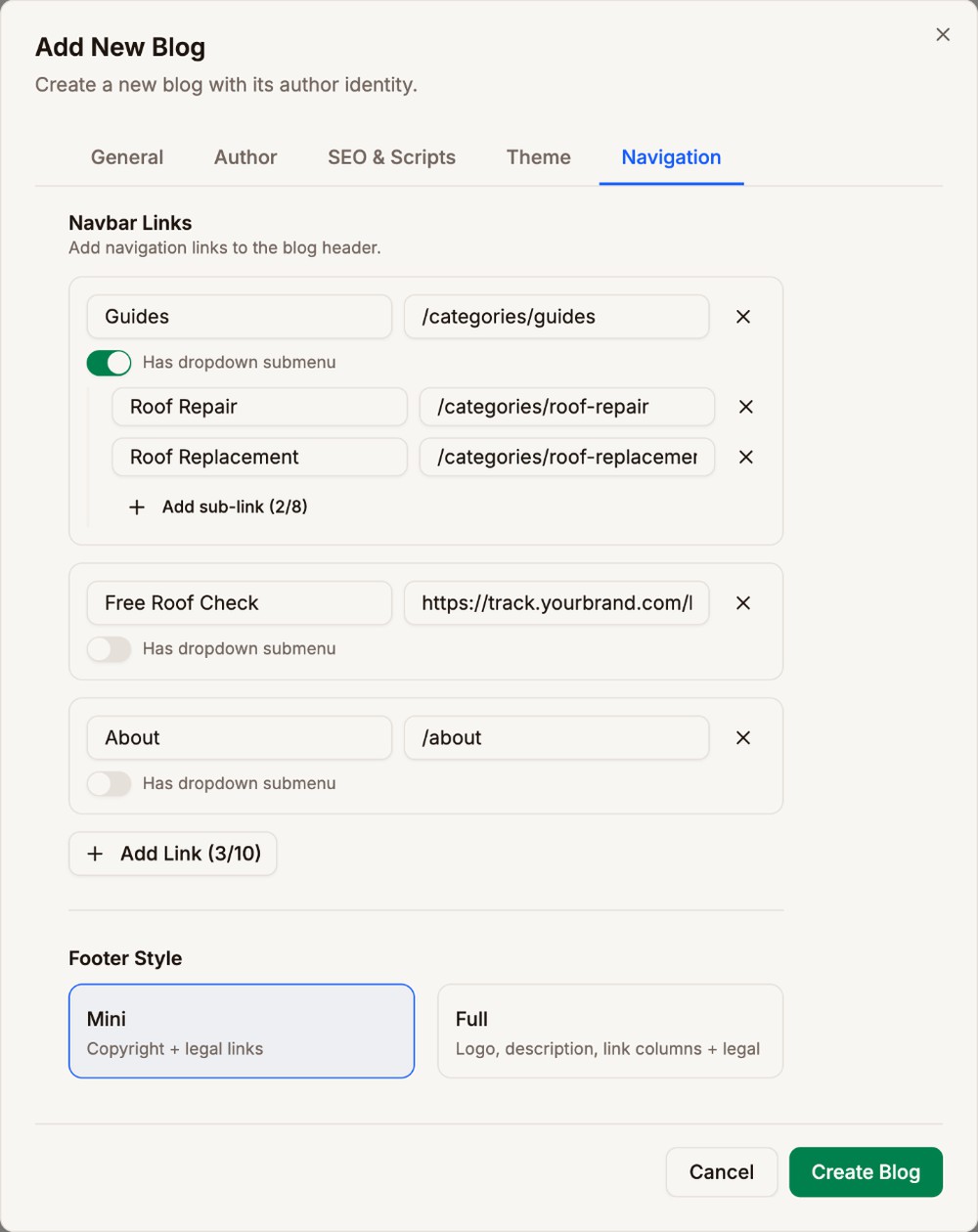
To add a header link:
- Click Add Link.
- Type the text readers see, such as
About. - Type where it goes, such as
/aboutfor a page on your blog, or a full web address that starts withhttps://.
To group links under one menu, turn on Has dropdown submenu and click Add sub-link for each one. The top link then only opens the menu.
| Limit | Value |
|---|---|
| Header links | Up to 10 |
| Links in each dropdown | Up to 8 |
| Link text | Up to 50 characters |
A link must start with / or #, or be a full address that starts with https://, http://, or mailto:. When you save, Proferex drops links with no text or with an address it can't use. Links to other websites open in a new tab.
Footer
Under Footer Style, pick:
- Mini, for a copyright line and links to your policy pages.
- Full, which adds your logo, a Footer Description, and columns of links.
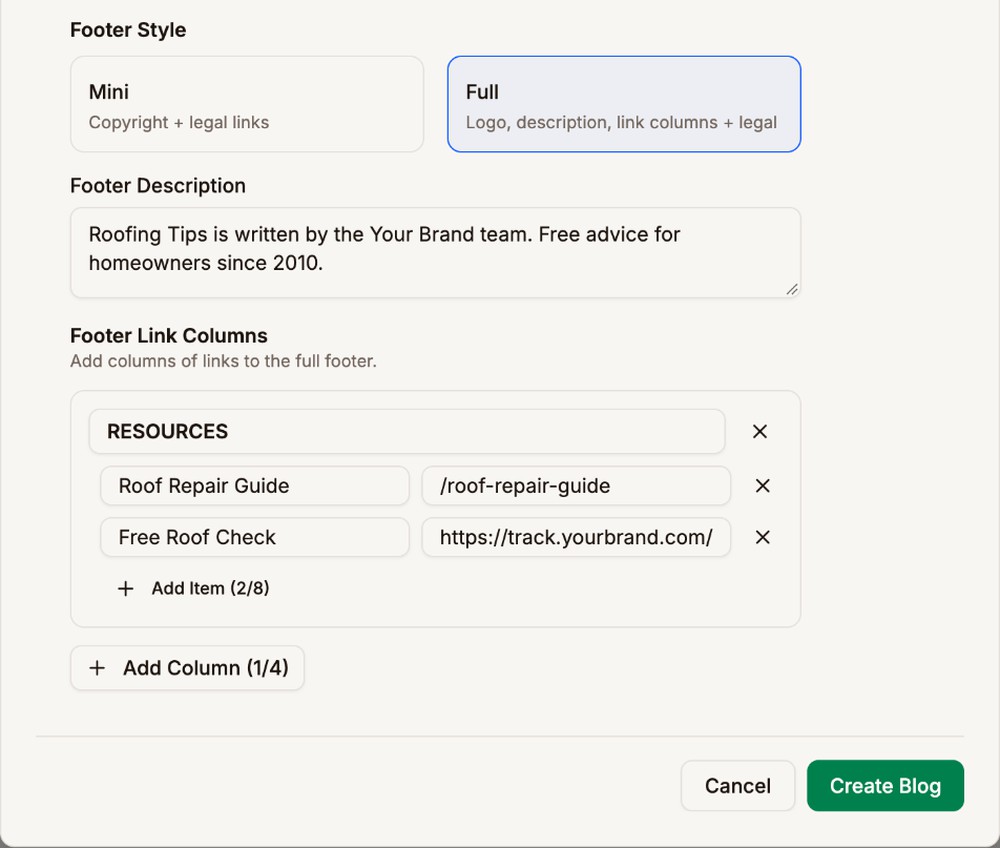
For a Full footer, click Add Column, type the column's title, and click Add Item for each link. You can add up to 4 columns of 8 links each.
Both footer styles show a copyright line with the blog name. They also link to Privacy Policy and Terms of Service once those pages are published.
Related articles
The Related articles section adds a list of other articles to the end of every article, so readers find what to read next. It picks articles that share the most categories with the one being read, newest first, and only ever shows published articles. A new article appears in the lists by itself, and an unpublished or deleted one disappears from them.
| Setting | What it does |
|---|---|
| Show related articles | Turns the list on or off for the whole blog. It starts off. |
| Heading | The title above the list, such as Related lessons or Read next. If you leave it empty, it says Related articles. |
| How many to show | From 1 to 10. Pinned items count toward this number. |
To show a particular article or page first, pin it. Pin it on a category to put it first under every article in that category, such as a main guide for the topic. See Categories. Pin it on one article to change only that article's list. See Articles.
If your articles already end with a hand-written list of related links, remove it once you turn this on, so readers don't see two lists.
Next step
Write your first article. See Articles.