

 VIII

Categories
Group your articles by topic.
This page shows you how to create categories, which group related articles on your blog, such as Roof Repair or Storm Damage.
Each category gets its own page on your blog that lists its articles, such as blog.yourdomain.com/categories/roof-repair. An article can belong to as many categories as you like. Its categories show on its card and at the top of the article, and each one links to the category page.
Go to Blog → Categories to see your categories. If you have more than one blog, each blog has its own tab, because every category belongs to one blog. Blog overview, next to the title, takes you back to that blog's overview.
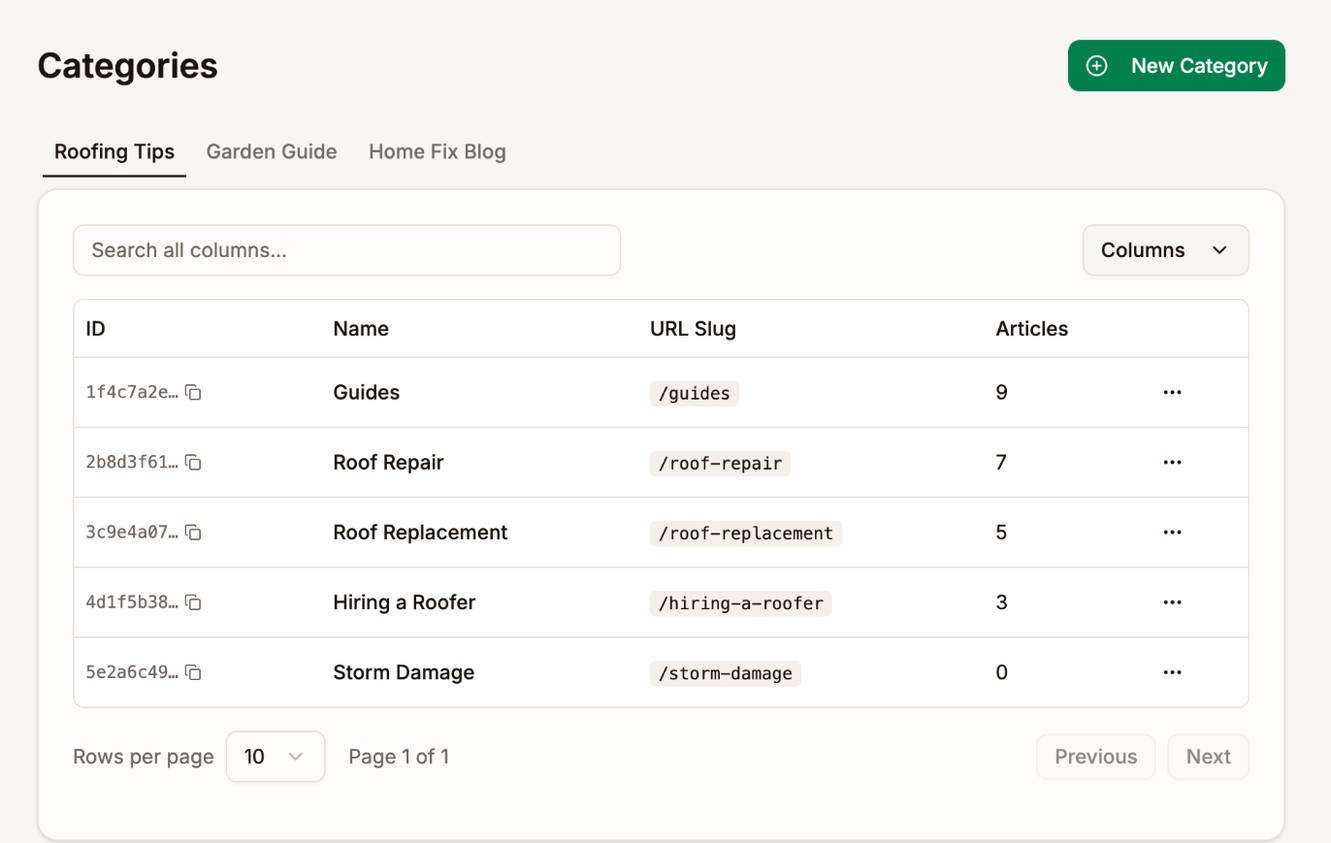
The Articles column shows how many articles are in each category.
Create a category
Create your categories before you write, so they appear as checkboxes in the article editor.
- Go to Blog → Categories.
- Click New Category. The Add New Category dialog opens.
- If you have more than one blog, pick the Blog.
- Enter a Category Name, such as
Gutters. The URL Slug fills in for you. - Fill in the other fields if you want to.
- Click Create Category.
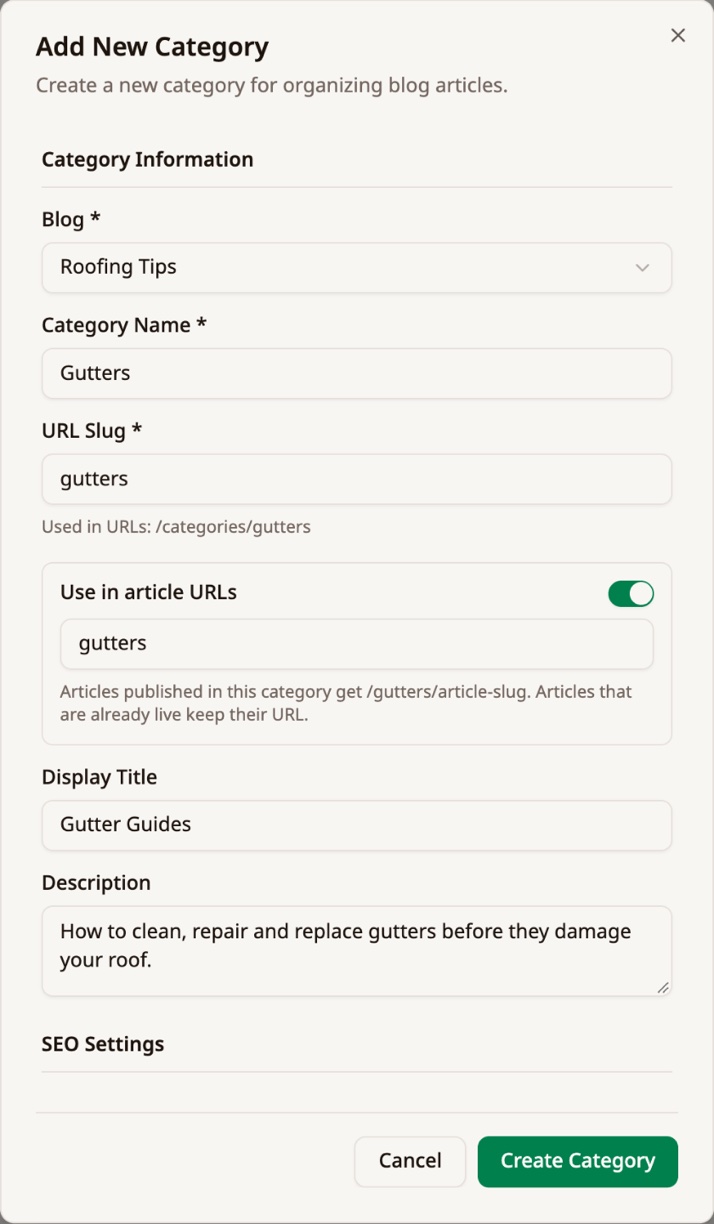
| Field | What it does |
|---|---|
| Category Name | The name on article cards and in the editor's checkboxes. Required. |
| URL Slug | The end of the category page's address, such as gutters for /categories/gutters. Required. |
| Use in article URLs | Puts the category in the address of articles published in it, such as /gutters/clean-gutters-safely. The URL name fills in from the slug, and you can change it. See Put the category in article URLs. |
| Display Title | The heading at the top of the category page. If you leave it empty, the name is used. |
| Description | The text under that heading |
| Meta Title, Meta Description | The title and description search engines show for the category page |
Two categories on the same blog can't share a URL slug.
To put an article in a category, open the article and tick the category under Categories in the right-hand column. Blog admins and editors can also add a category from there: click New category, type the name, and press Enter. The new category is ticked straight away. See Articles.
Edit or delete a category
Click a category's row, or open its menu and click Edit, to change it. Open the menu and click Delete to remove it. The number in the Articles column opens your article list filtered to that category. A Showing chip above the list names the category; click its × to see all articles again.
Changing the URL Slug changes the category page's address. Links to the old address stop working.
Deleting a category doesn't delete its articles. They stay published and leave the category. An article with no categories left shows as Uncategorized in your article list.
Put the category in article URLs
An article's address can include its category, such as blog.yourdomain.com/roof-repair/signs-roof-needs-replacing instead of blog.yourdomain.com/signs-roof-needs-replacing. It tells readers and search engines what the article is about before they open it, and a language blog can keep each language under its own path, such as /hindi/the-thirsty-crow.
There are two ways to turn it on:
- For the whole blog. In Blog Settings, set Article URLs to
/category/article-slug. Every category gets a URL name from its slug, and new categories get one too. If a slug can't be used, such as a word the blog uses for its own pages, Proferex lists the category so you can give it a URL name yourself. - For one category. Edit the category and switch on Use in article URLs.
Only articles published from then on get the category in their address. Articles that are already live keep the address they have, so no link to them breaks. An article with no category stays at /article-slug.
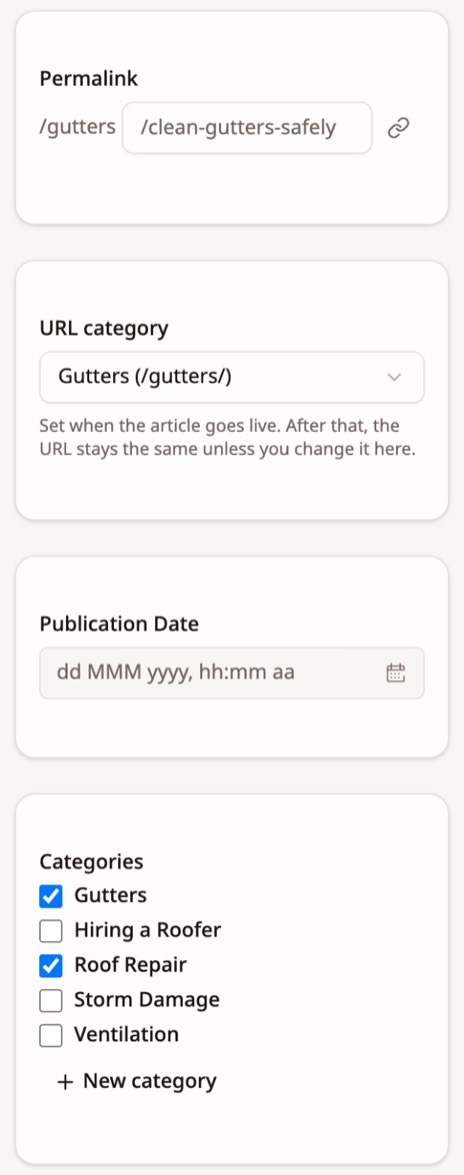
When an article is in more than one category with a URL name, it uses the first one you ticked. To pick another, or to leave the category out of one article's address, use URL category in the article editor.
To move articles that are already live, edit the category. Under the URL name, Proferex shows how many of its live articles still use /article-slug. Click Move to /url-name/ to move them. Their old addresses keep working and send readers to the new ones.
Changing a category's URL name later only affects articles published after the change. To stop using it for new articles, switch off Use in article URLs.
Pin items in related articles
When your blog shows related articles at the end of each article, a category can put chosen articles or pages first in that list. A language blog, for example, can pin its Learn Malayalam page on the Malayalam Stories category, so every Malayalam story points readers to it.
Open the category and use Pinned in related articles. Pick an article or page to add it, use the arrows to change the order, and click × to remove one. Pinned items show in this order, before the articles picked automatically. A draft is skipped until it is published. To turn related articles on, see Blog Settings.
Next step
Upload the images for your articles. See Media Library.